
How to Plan Corporate Garden Maintenance Around a Busy Workplace

FOURWAYS CORPORATE GARDENS · WORKABLE ROUTINES, WELL-KEPT SPACES
A garden team arrives just as visitors queue at reception. Cars occupy the area beside the hedge, a delivery vehicle blocks the service gate and a meeting is taking place next to the lawn. The work may be straightforward, but the timing makes it awkward.Corporate garden maintenance works better when the garden brief includes the way the workplace operates. Access, occupied areas, visitor routes and communication matter alongside mowing, planting and tidying.
For businesses in Fourways, planning these details can make an ordinary visit easier to coordinate. This guide focuses on the day-to-day arrangements to discuss with Hilltop’s corporate garden team, rather than assuming a particular package or visit schedule.
Start with the business day
Map the busiest arrival, delivery and visitor periods. Identify the garden areas affected, then agree a realistic order of work and a contact who can deal with changes.
Map how people move through the property
Look at the entrance from a visitor’s perspective. Follow the route from parking to reception and note where people cross lawns, pass hedges or wait near planted areas. Include staff shortcuts and the route used for deliveries.
Discuss these routes before agreeing working arrangements. A planting bed beside a quiet boundary presents different coordination questions from a narrow strip alongside the main pedestrian gate.
Mark emergency access and other routes that must remain available under your site procedures. The gardening provider needs clear instructions about the property’s operating requirements; it should not have to discover them when equipment is already on site.
Choose work windows by area, not just by clock time
“Come early” can mean the same time that staff arrive. “After lunch” may coincide with deliveries or visitors. Describe the actual patterns instead of relying on a time that sounds quiet in general.
Ask whether the proposed service can be organised in a sensible sequence. Work near the entrance might suit one period, with less sensitive areas addressed at another. Availability and task requirements still need confirmation; do not assume out-of-hours attendance is included.
Tell the provider about recurring events and unusual days. Training sessions, stock deliveries or a client function can change the usable space temporarily. A small amount of notice is more useful than redirecting the team repeatedly on arrival.
Separate routine work from work needing special arrangements
Not every task has the same effect on the premises. Ordinary bed care, work near parked cars and a substantial pruning or repair project need different conversations. Identify the tasks likely to require temporary access controls, extra space or another specialist.
Ask the provider how the work will be carried out and what the business must arrange. Do not prescribe equipment or methods you are unfamiliar with. The purpose of the brief is to make constraints clear and allow the appropriate people to plan the task.
For the broader scope, use Hilltop’s existing guide to corporate garden maintenance contracts. Once the task list is agreed, this operational plan helps turn it into a practical visit.
Give the team a reliable arrival process
Confirm the correct gate, any booking procedure and the person who will authorise entry. Explain where a vehicle may stop and where equipment can be unloaded without obstructing ordinary movement.
If access depends on a receptionist or security desk, make sure that person has the booking details. A written arrangement is easier to follow than asking the team to phone several staff members at the gate.
Tell the provider which areas are restricted and whether an escort is required. Share sensitive access information through your normal secure process and only with the people who need it.
Make pedestrian access part of the conversation
Discuss how work areas and ordinary routes will be kept distinct. People often continue along a familiar path even when maintenance is under way. Agree how site staff will communicate changes and who is responsible for any temporary arrangements.Consider debris, equipment and wet surfaces where garden care meets cleaning or irrigation. The UK Health and Safety Executive’s cleaning guidance highlights wet floors and trailing equipment as practical slip and trip concerns. It is a useful operational reference, not a statement of South African legal requirements.
Your own site procedures and competent task planning remain important. Ask about the circumstances on your premises rather than treating a sign or a general checklist as a complete solution.
Coordinate gardeners, cleaners and other contractors
A recently cleaned entrance can collect garden debris if work beside it starts immediately afterwards. Irrigation running at the wrong point in the sequence can also affect nearby areas. Give each provider enough information to understand the other work taking place.
Choose an order that suits the tasks and the site. For example, discuss whether garden work beside an entrance should be completed before the final clean of that area. Confirm arrangements with both teams rather than assuming one will automatically wait for the other.
If you also need office cleaning or irrigation work, identify it separately in the brief. A single property contact can coordinate the conversation while keeping each quotation and task list clear.
Use one contact and one short visit note
Name the person who can answer questions during the visit and a backup if they are unavailable. Make clear who may approve additional work. A suggestion from a staff member should not accidentally become an instruction outside the agreed scope.
Ask what feedback the provider can give after a visit. A concise note might identify work completed, access problems, an observed issue requiring assessment and any decision needed from the business.
Photographs help when they show a specific issue, such as a bed blocked by stored materials. There is little value in a large reporting process that no one reads. Agree the level of detail that helps you make decisions.
Plan for changes in the garden itself
Growing plants can alter clearance around paths, signs and seating. A maintenance routine should notice those changes, but repeated cutting is not always the best long-term answer. Ask whether a difficult area needs a separate planting or layout review.
Consider mature size and maintenance access when adding new features. The RHS garden-planning guide explains the value of mapping fixed features and dimensions before design decisions. At a workplace, include the routes and uses that must continue to function.
Bring recurring problems to a periodic review. If the same area is blocked every visit, the arrangement may need a practical change rather than another reminder in the report.
A compact maintenance coordination brief
- Property location and nominated contact.
- Arrival gate, booking process and unloading arrangements.
- Busy arrival, visitor and delivery periods.
- Routes and areas that must remain available.
- Tasks requiring extra space or separate planning.
- Other contractors working nearby.
- Authority for additional work and the feedback process.
Review this brief when the business changes its hours, the garden layout changes or a new person takes responsibility for the property. The most useful document is one that still reflects how the site works.
Frequently asked questions
Must garden maintenance happen outside office hours?
Not necessarily. The right arrangement depends on the work, the premises and provider availability. Discuss the actual busy periods and confirm any proposed attendance window and its cost.
Can the receptionist coordinate the visit?
They can be part of the access process, but the provider also needs someone authorised to answer scope questions and approve changes. Make the responsibilities clear.
What if a booked area is unexpectedly unavailable?
Contact the provider as early as possible. Agree whether the order of work can change, what can still be completed and whether a return visit needs separate arrangements.
What should we ask Hilltop first?
Describe the Fourways premises, garden areas and operating constraints. Hilltop’s corporate garden page describes assessing the garden and developing a plan with client input. Confirm the tasks, visit arrangements and quotation for your site.
Plan garden care around your workplace
Tell Hilltop about your Fourways premises, access arrangements and busiest periods. Discuss a garden maintenance plan that reflects the property and the way your business operates.
Call 011 807 3773 or send an enquiry through Hilltop’s contact page.
Explore Corporate Garden Services
Hilltop · Practical care for your home, workplace and outdoor spaces.
More on Body Corporates & Commercial

A Communal Garden Checklist for Fourways Body Corporates
A practical monthly walkthrough for Fourways trustees and managing agents, covering shared paths, lawns, planting, irrig…

What Should a Corporate Garden Maintenance Contract Include?
A practical guide for Fourways businesses comparing corporate garden maintenance: scope, visit schedules, waste removal,…
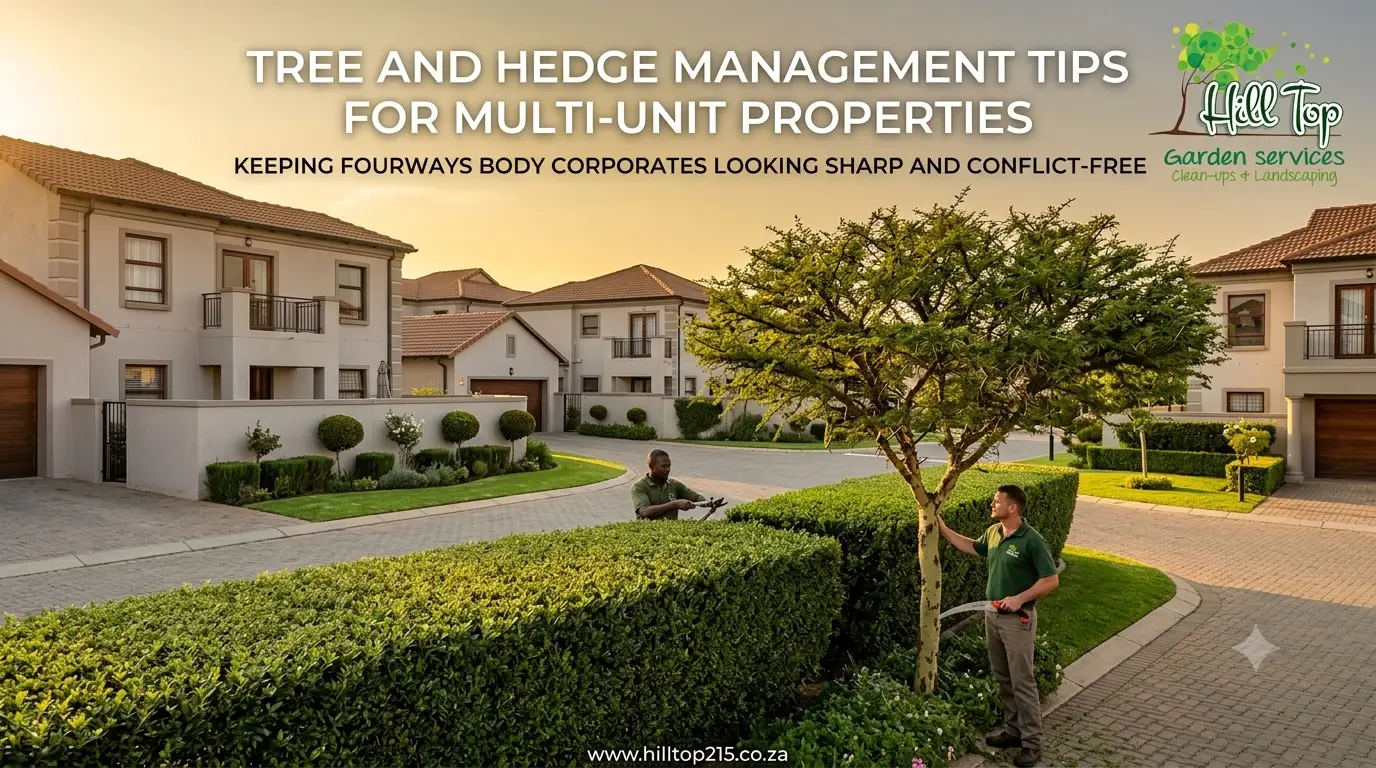
Tree and Hedge Management Tips for Multi-Unit Properties: Keeping Fourways Body Corporates Looking Sharp and Conflict-Free
If you’ve ever served on a body corporate in Fourways, you’ve probably seen it happen. One resident loves the big tree t…