

I’ll be honest with you: the first time a client in Johannesburg asked me to build them a “proper Japanese garden”, I almost laughed out loud. Not because it was a bad idea — because I knew exactly how many times I’d seen well-meaning people try to recreate Kyoto in the Highveld and end up with a sad rock pile surrounded by thirsty moss that died in week two.
But then we started experimenting.
Over the last decade at Hilltop Garden Services we’ve built Japanese-inspired gardens from tiny Sandton courtyards to sprawling Constantia estates, and we’ve learned something important: you don’t copy Japan — you translate it. You take the principles of calm, balance, simplicity and deliberate imperfection, then reinterpret them using plants, materials and weather patterns that actually survive (and thrive) in South Africa.
The result? Gardens that feel deeply peaceful, look expensive without being flashy, photograph like dreams, and — most importantly — don’t die the moment the first heatwave or winter frost hits.
Here’s the real, no-BS guide to creating a Japanese-inspired garden that feels authentic, works in our climate, and might just become the most photographed corner of your property.
The Core Japanese Garden Principles (And How We Bend Them for SA)
Japanese gardens aren’t about cherry blossoms and bamboo everywhere (although we’ll get to those). They’re about:
- Ma — negative space / breathing room
- Wabi-sabi — beauty in imperfection and age
- Shakkei — borrowed scenery (making the garden feel bigger)
- Balance & asymmetry — nothing too perfect or symmetrical
- Natural materials — stone, gravel, wood, water
- Restraint — less is more, always
We keep every single one of those principles — but we swap plants and details so they don’t become expensive disappointments.
Step 1: Choose Your Core Elements (The Non-Negotiables)
Every Hilltop Japanese-inspired garden starts with these four anchors:
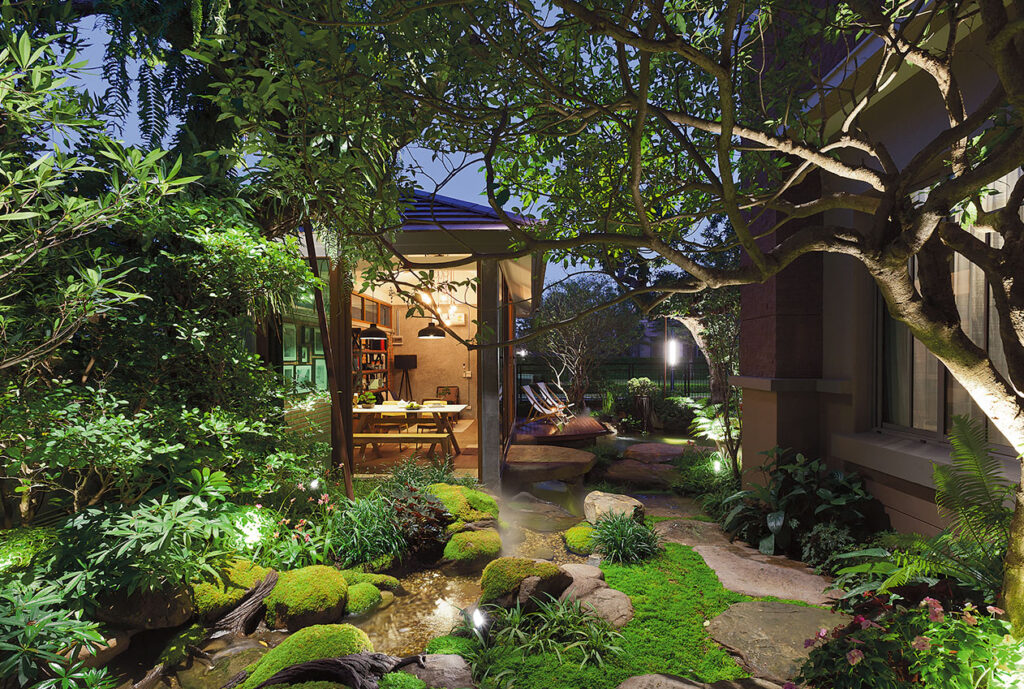
- Gravel / Stone Sea The most important element. Use crushed stone (grey, white or black), river pebbles, or decomposed granite. Rake it into patterns — ripples, waves, or straight lines. In SA we prefer slightly larger stone (5–10 mm) because fine gravel blows away in our wind.
- Large Statement Rocks Three, five or seven rocks of different sizes, never in a straight line. One big “mountain” rock, a few smaller “islands”. We source local sandstone, granite or quartzite — much cheaper and more authentic-looking than imported Japanese stone.
- Water (Real or Suggested) A small pond, rill, or even a dry stream bed made of smooth river stones. If you can’t do real water (cost, mosquitoes, maintenance), the dry stream illusion works brilliantly — we’ve done dozens and people still do double-takes.
- Pathways of Stepping Stones Uneven, irregular, slightly meandering. Force people to slow down and look where they step — that’s the mindfulness bit. Use local slate, sandstone or concrete pavers with a natural finish.
Step 2: Plant Selection – The South African Translation
This is where most Japanese garden attempts in SA fall apart. You can’t just plant Japanese maples and moss and call it a day — our sun and dry winters will murder them.
Here’s what actually works and still gives the right feeling:
Structural / Evergreen Backbone
- Podocarpus falcatus or P. henkelii (yellowwood) — clipped into soft clouds
- Pittosporum tenuifolium (silver sheen) — small-leafed, light green
- Rhaphiolepis indica — dense, glossy, easy to shape
- Carissa macrocarpa (num-num) — glossy dark green, white flowers, edible fruit
Texture & Movement
- Restio species (Cape reeds) — tall, wispy, grass-like
- Aristida junciformis (Ngongoni three-awn) — soft swaying plumes
- Miscanthus sinensis (silver grass) — elegant fountain shape
- Carex ‘Frosted Curls’ — fine silvery strands
Colour & Seasonal Interest (Used Very Sparingly)
- Azalea indica (shade only) — soft spring pinks
- Camellia japonica — winter/early spring flowers
- Clivia miniata (orange or yellow) — shade-loving
- Dietes grandiflora — white iris-like flowers all year
- Crassula ovata (jade) — sculptural succulent
Groundcover & Moss Alternatives
- Selaginella kraussiana (spikemoss) — shade, looks mossy
- Soleirolia soleirolii (baby’s tears) — shade only
- Plectranthus verticillatus — shade groundcover
- In sunnier spots: blue chalk sticks or low sedums
We almost never use Japanese maple (too thirsty), true moss (dies in our sun), or bamboo (invasive nightmare unless clumping varieties).
Step 3: Lighting & Finishing Touches That Make It Feel Authentic
- Stone lanterns — one or two only. We use local concrete or sandstone versions — cheaper and more durable than imported granite.
- Low-voltage warm LED uplights — on key rocks and trees for evening drama.
- Deer scarer (shishi-odoshi) — if you have water, the bamboo tipping sound is hypnotic.
- Simple timber bench — raw wood, no varnish, slightly weathered.
The Viral Recipe: How These Gardens End Up All Over Instagram
- Golden-hour drone shot flying over the gravel sea and stepping stones
- Close-up of raked patterns with dew drops
- Time-lapse of seasonal change (especially autumn grasses + winter aloes)
- Someone barefoot walking the path with caption “Instant calm”
We’ve had clients’ gardens featured on travel pages, architecture blogs, wellness accounts, even local news because the contrast between the calm Japanese aesthetic and the surrounding South African landscape is so striking.
Want a Japanese-Inspired Garden That Actually Survives South Africa?
At Hilltop Garden Services we don’t do cookie-cutter copies. We translate the spirit of Japanese design using plants, stone and materials that love our sun, wind and water restrictions.
Drop us a photo of your current garden (even if it’s just a boring lawn or empty courtyard) and we’ll send you a free concept sketch showing how we’d create your own peaceful retreat — no obligation, just good ideas.
Let’s build you a garden that feels like a deep breath every time you step outside.
For more information, visit our website Hilltop Garden Services or call us at (011 807 3773)
Follow us on social media for the latest updates and inspiration for your outdoor space.
Hilltop Garden Services – Keeping your outdoor spaces beautiful, efficient, and effortless all year round.
Recent Comments